
I collect, and have used, many different cameras. I love to study history, and especially the history of photography – and I’m a huge fan of medium format film… so it was only natural that I would one day own a Hasselblad.
First, I should mention (as you probably already know) Hasselblad cameras are expensive. I avoided spending money on one of these until I found out that a friend (that I knew from high school back in 1977) was interested in selling his. It took him a while to decide to part with a Hasselblad, but after some time he decided to sell some of his equipment to me. I bought his 500cm body with a couple film backs and a couple lenses, plus a few miscellaneous items that he had. Finally, I was a Hasselblad owner!
At first, I was a bit nervous about this camera since I had read stories about simple things like removing and re-attaching lenses that could be tricky. Or how you had to watch the small indicators on the side when attaching or removing a film back, and how not doing it right could make things not work, or worse, lock up and not be usable. Well, after having, and using the camera for a couple years, I will say, things can be a bit tricky, but it’s not that bad – not end of the world bad – just minorly irritating at best. I’ve only had a lens attaching/detaching issue a couple of times and was able to re-align the spring-loaded little cams pretty easily. In fact, the couple issues I did have proved to me that I had nothing really to fear. Paying attention to what I was doing, and remembering a few things saves a few minutes of resetting things. I will mention that you can buy a small screwdriver type tool, made specifically for Hasselblad cameras, that will make these fixes pretty easy. I think I bought mine online from Adorama or B&H – I can’t remember which, but the whole issue isn’t that big of a deal, unless (or course) you force things (which you know you should never do) and break something. These cameras are made mostly of steel – so the big worry would probably be bending some metal piece if you force something. Normally, lenses and backs snap into place very smoothly – so forcing them is not ever necessary.
So, after avoiding spending the money on a Hasselblad, and waiting all these years to actually own and use one, what do I think now? Was buying a Hasselblad a waste of time and money? A Hasselblad 500cm with lens, film back and finder, in good condition (even in not so good condition) is going to cost over $2,000 on eBay. The better the condition, and the newer it is, the more it will likely cost. My conclusion is that I’m extremely glad my friend sold me his equipment, and that I’ve had the opportunity to use this camera. I will say, it is one of the most interesting (not in an odd way) and satisfying cameras that I’ve ever used.

Let me introduce you to my Hasselblad. The 500cm is a completely manual camera. There is no metering capability built in – external meters are available – but I choose to meter with my handheld Sekonic Studio Deluxe. These cameras were very modular – much like Nikon and Canon have built “Systems” of camera components (lenses, backs, winders, finders, etc.) that were all interchangeable, Hasselblad built that same kind of system around the 500cm (and other V series bodies). Lenses were all made by Carl Zeiss in Germany, so there is some very good glass (also not inexpensive) available for these cameras. I have an 80mm f/2.8, and 50mm f/4 and a 150mm f/4. These 3 lenses satisfy most of my needs, but there are others that are very nice – I just don’t have the need, or the dollars to afford them all.
So, I mentioned above that the 500cm is interesting. I should explain. I’m comparing to a few other medium format cameras that I’ve used. Primarily the Zenza Bronicas, and the Mamiya SLRs (RB67), and I’ve also used Mamiya TLR cameras (which I like very much). So, what differentiates the Hasselblad from the others? In a word, I would say “Simplicity”. Now, the Hasselblad is not simple – it’s a very complex camera. But the complexity is hidden very well from the user. In other words, I don’t have to care about all the complex things that are happening under the covers. If I follow a few basic rules when attaching lenses, loading film, and all that, everything functions flawlessly.
In our digital world, with everything controlled through electronics, this seems trivial – but let me tell you, it is not. I love my RB67 (especially the larger negatives it makes) but Mamiya chose to separate the shutter cocking operation from the film advancing operation on this completely manual camera – whereas Hasselblad made both functions work, completely mechanically, with one crank – that feels, and sounds very nice by the way. Bronica did this on their cameras – but the older ones were focal plane shutters, not shutters in the lens. Having the lens communicate to the body and the film back communicate to the body, and all that work together mechanically is very complex. Some other companies were able to make this work, but I like the way Hasselblad did it best. Bronicas, like the SQ-Ai, are nice too, but electronics really assist them in making everything work together.
How does the Hasselblad work, and how does it feel when taking photos? Well, it fits well in my hand, and is small enough to hand hold – which I do from time to time – but honestly, I enjoy using medium format cameras on the tripod. That is their natural environment – attached to a tripod. I love being able to look through the waste level finder with no hands on the camera. I love the way my subject looks when I’m looking down into the finder (of course everything’s backwards/mirrored – so images show up on the opposite side of the finder when panning). I love aligning vertical lines in the waste level finder. I feel like I can align my scenes better in the larger finder (compared to a 35mm finder). Now, speaking of the finder, the square format is odd at first – and maybe you won’t find it perfect for all subjects – but I have really come to like it – I think I might like 4×5 or the RB67 6×7 format as much, but I like these more than 35mm. Square, or slightly rectangular is nice, but everyone (obviously) doesn’t agree.
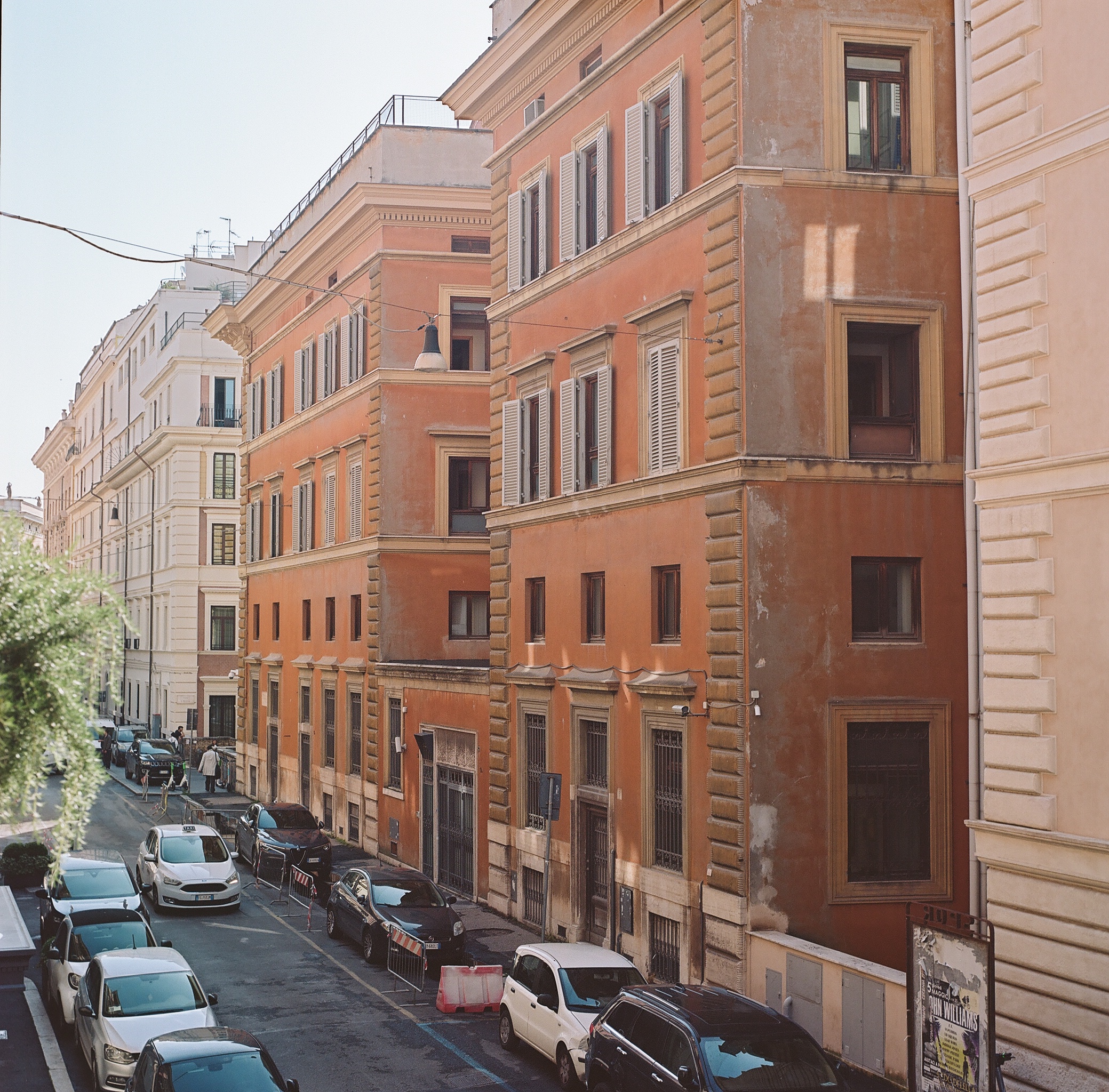
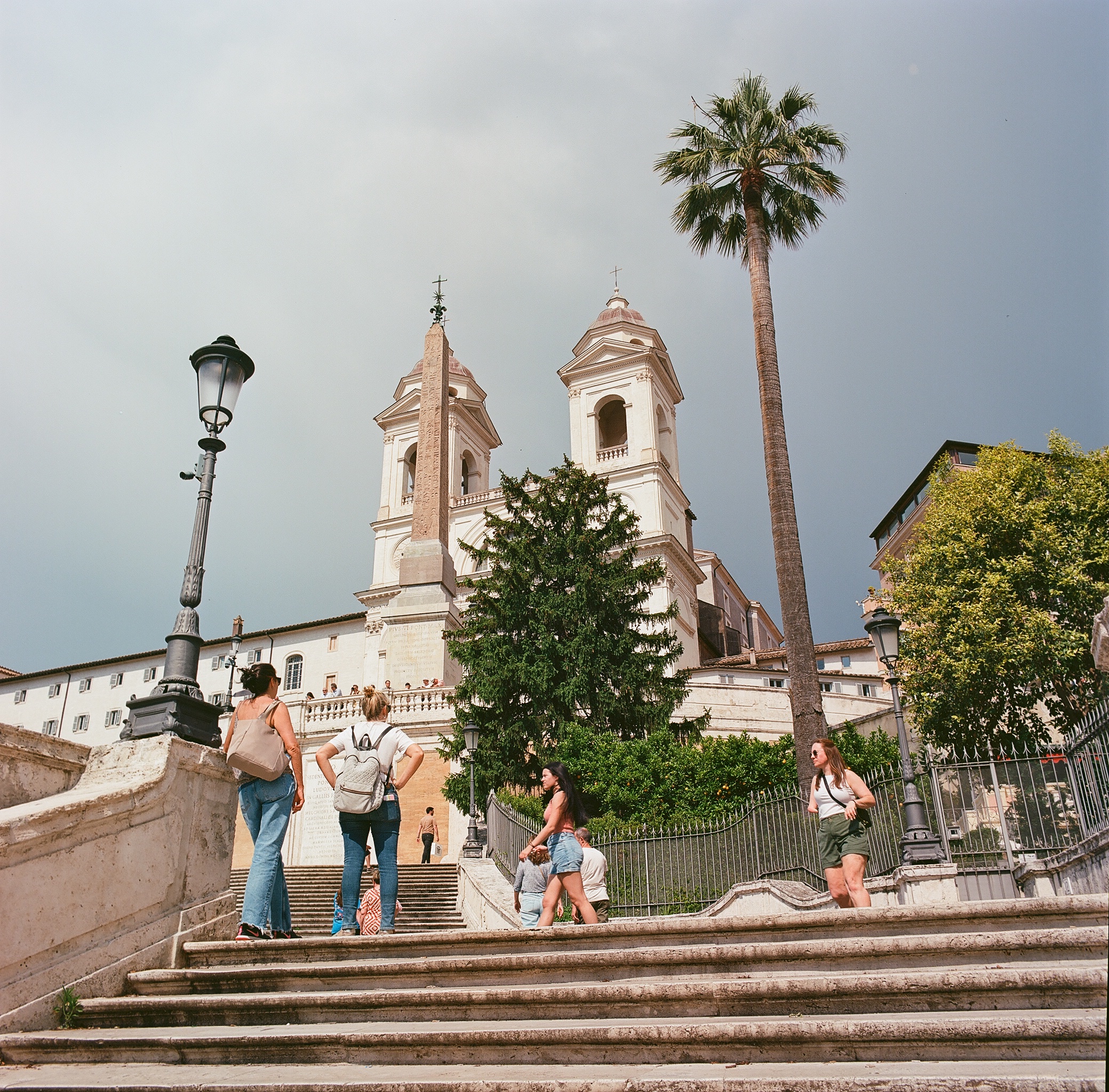
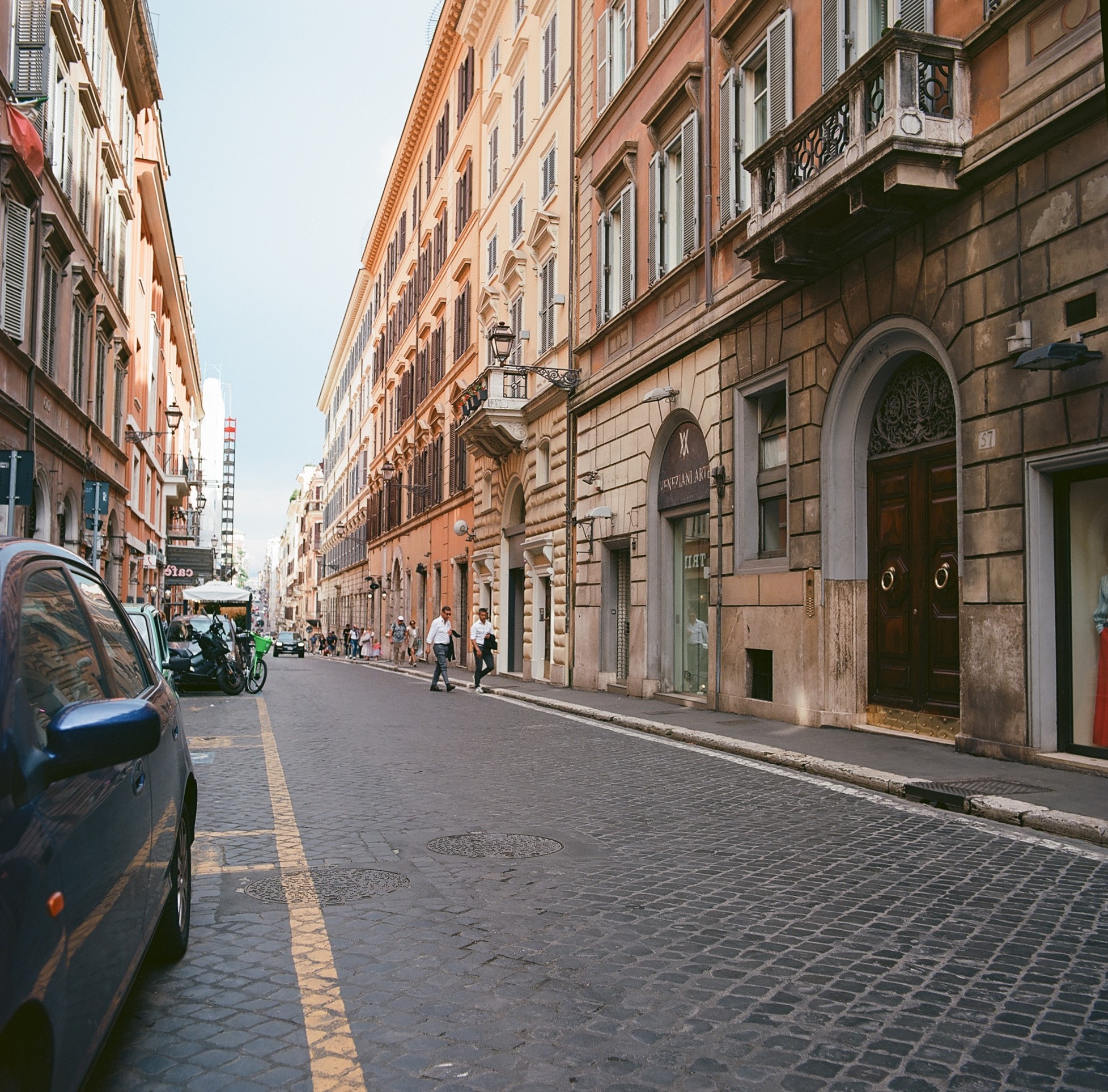
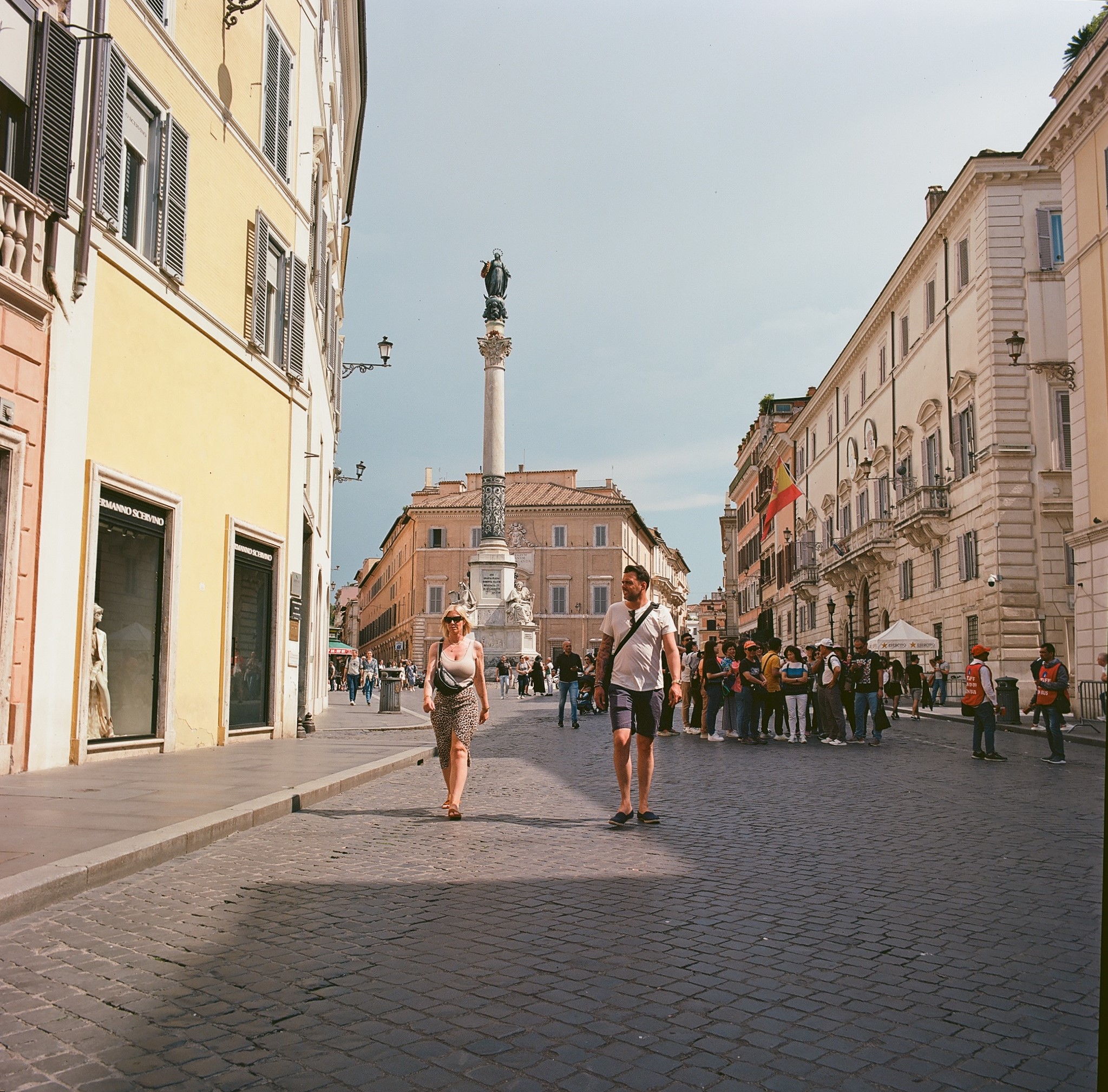
I took my Hasselblad on a recent trip to Rome and it was fun to take some photos with it, but it’s much slower than using my digital camera. Fun, but slow. Slow isn’t bad, I think. It’s fun to take time to visualize a scene, to take a meter reading, or just guess on exposure (when you take one reading, you can guess pretty easily in daylight). I didn’t get to walk around at sunrise or sunset, like I planned. Other things took priority, but here’s a few shots from my Hasselblad in Rome. All handheld, shot with my 80mm lens on Kodak Portra 160 – one of my favorite films.

So, there you have it. My opinions, thoughts, comparisons – for what they’re worth. I’m not giving you a technical review, discussing every feature of the 500cm, but what I am giving you are my thoughts, my reasons I like to use the 500cm, and maybe a few reasons you might like to try one. I, needless to say, highly recommend this camera. I haven’t used any of Hasselblad’s newer models, but the 500cm is a solid, basic, and (in my opinion) easy to use camera – but you have to do things the right way, or you could run into problems. For me, none of the problems I’ve encountered were unsolvable/unfixable.
If you get a chance to try a Hasselblad 500cm, I think you’ll like it. And have fun shooting film!
 Mostly Film Photography (GotFilm.org)
You must be logged in to post a comment.