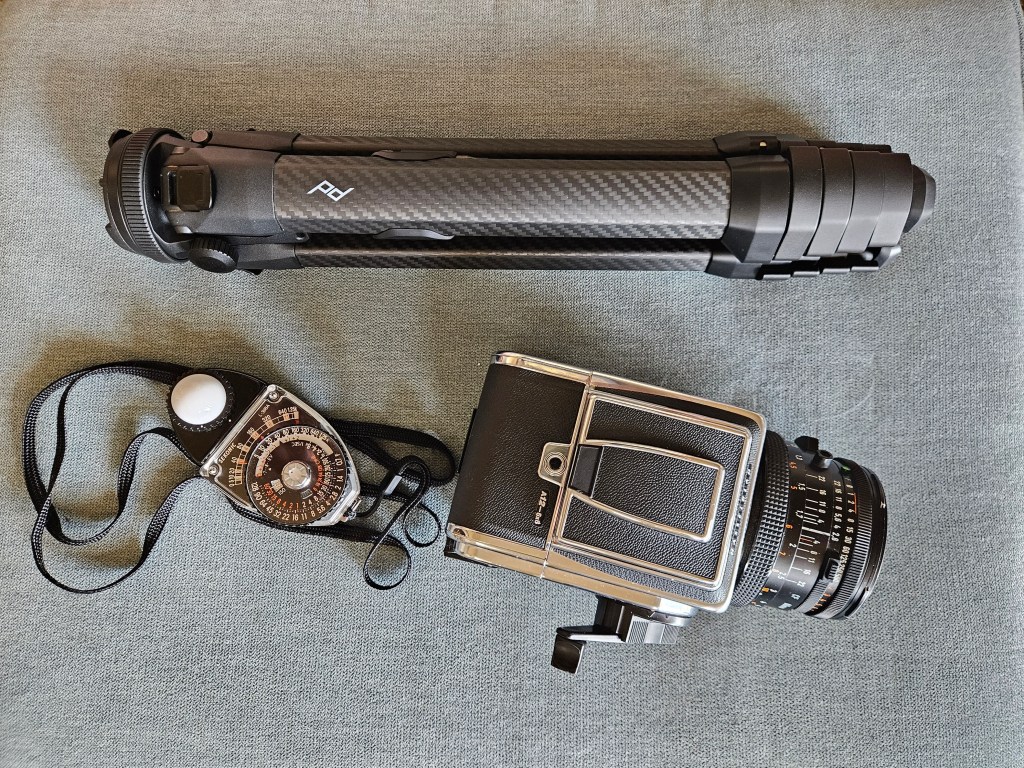
I’ve been looking for a reliable travel tripod, one that worked for me, for a while now. Weight isn’t my biggest requirement – I’m more interested in portability/size for packing in my suitcase. I don’t backpack, or hike great distances, but some of the airports I fly in and out of are smaller, and the planes that fly to those airports are smaller planes (like Durango, CO, or Bangor, ME) so I’m trying to pack my gear in as small a space as possible.
I was researching several tripods, and after seeing Peak Design’s offering, I was intrigued. There are only a couple negatives that I’ve encountered so far, and those very well could be offset by the positives of this tripod. But you can decide that for yourself, after I explain.
I could only find a few tripods that I would consider “True” travel tripods. I was trying to avoid some of the cheaper built ones out there – some of those don’t have a really solid feel to them. Whatever I ended up with needed to have a very solid feel, regardless of how small it was. Let me review some of my other requirements before getting into the specifics of this tripod.
First, to qualify as a “Travel” tripod, it had to be short enough, and thin enough when packed. Traditional tripods are usually too long, or too fat when packed. Most of the other tripods I have, if they can be compressed down short enough, they end up being too thick – they just take up too much space in my suitcase.
Next, I wanted my travel tripod to be fairly simple to operate. I didn’t want to have too much of a process to set it up, or take it down, and I didn’t really care if it used the same parts as my other tripods, since it would be fairly specialized, and would be used apart from any other tripods I have.
Third, it had to feel strong and sturdy when I use it. For my purposes, I’m not going to hold a 20 or 30 pounds of camera and lens on it. In fact, my primary use would be for holding my Hasselblad film camera (500cm) which is not too heavy. However, I still want to have it be sturdy when in use. And the quality must be high enough to last many years (forever would be nice).
So, those are my big three requirements. I don’t think I’m asking for too much. I feel like the Peak Design tripod meets these requirements nicely, however (and this leads to my first negative) the Peak Design travel tripod is easily one of the more expensive tripods in its class on the market. The carbon fiber version is listed at $650 ($380 for aluminum) on the Peak Design website. Is the tripod good enough to overcome the sticker shock when you see the price?
Let me say, initially I am very pleased with the size/portability of this tripod. I’m very happy with its quality and sturdiness. I truly believe it’s one of the best built tripods, if not the best built tripod, I’ve ever used.
There are a few things you should know about this tripod. First, I supposed this is a good point – it uses standard arca-type plates on the integrated ball head. The ball head is a proprietary head built onto the extendable center post. So, you’re not going to be switching heads on this tripod. It’s compact, and this feature helps keep it compact and simple. Maybe I’m wrong, but I don’t think being able to switch/replace the head is a big need on this type of tripod.
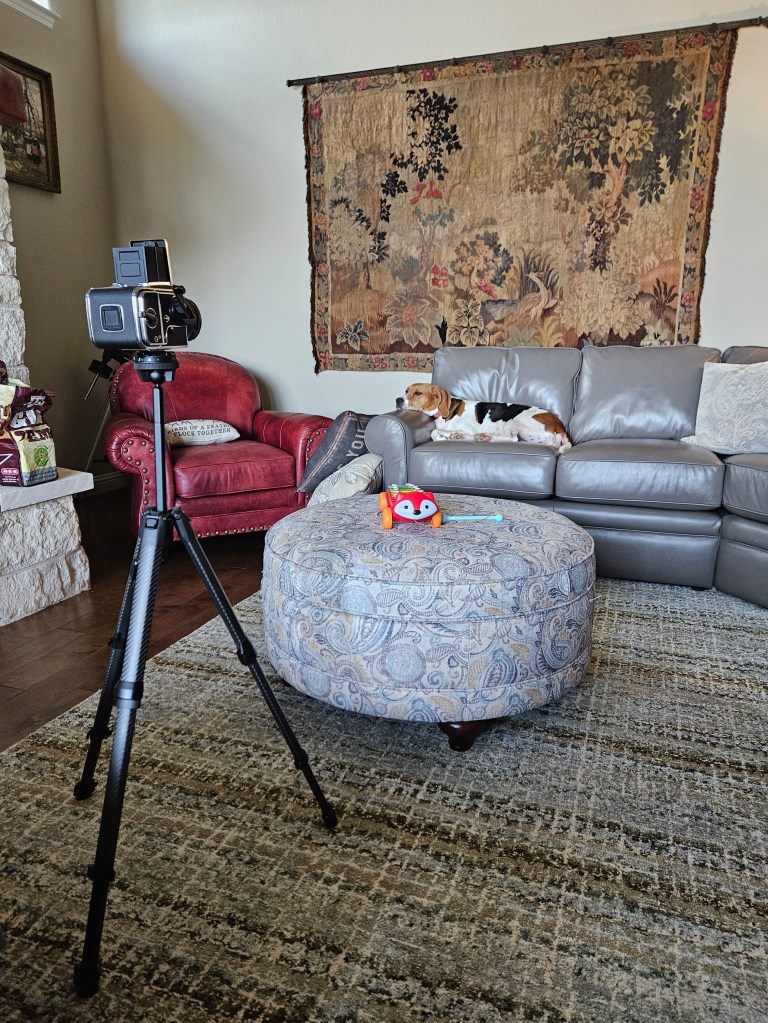
There is a dial on the head that loosens or tightens the ball. To make it more compact, the use of knobs has been reduced to one (it can be pressed in to make it recessed for packing) which loosens or tightens the center post. I actually find that this works well, and the integrated ball head is not a problem – it meets my needs perfectly. There is one negative here though (not a big deal for me really) – when I want to pan, I have to do so by loosening the ball. Some (maybe most, or all) traditional ball heads have a knob you can loosen for panning only – which won’t interfere with the ball. With this head you have to loosen the ball to pan. Again, this isn’t a big deal – and the idea of more potability is a higher priority for me.
Mainly due to the way the integrated head works, the tripod ends up being fairly simple to operate – not overly complicated. So, I believe my need for fairly simple operation is met, while it’s still rich enough in features to do most everything I would need. The legs spread out with standard thumb operated spring locks – so the legs can easily be spread almost flat to accommodate shooting about 8 or so inches above ground level. If you need to shoot closer to the ground, the center post can be reversed – however, this really isn’t practical for use with my Hasselblad (I supposed I could try, but that would be pretty hard). For use with digital cameras, this would work fine, and you could get right to ground level.
As far as stability goes, this tripod is very good. There’s even an integrated hook to hang a weight (camera bag, etc.) on to provide extra stability for the tripod.
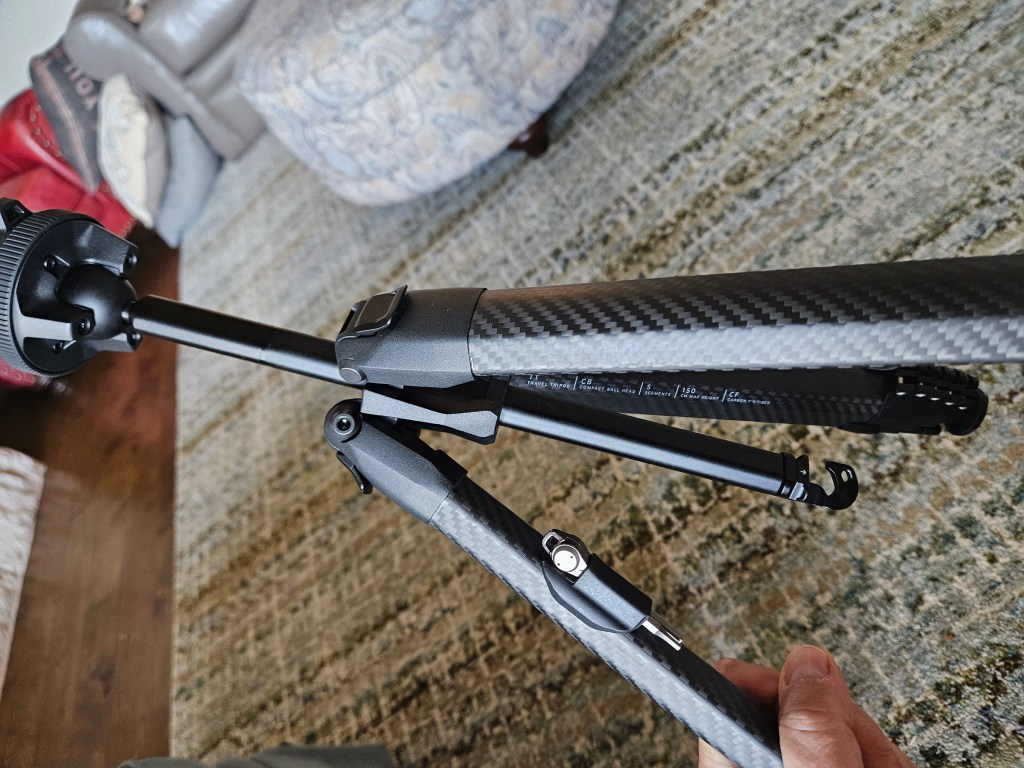
The carbon fiber version (which is what I am trying) feels solid even with the legs extended all the way, although I wouldn’t extend the last section of leg when using my Hasselblad and waist level finder. If I were using the DSLR or Mirrorless camera, it would be just about eye level completely extended. I measured it at about 60″ from ground to the ball head. The last extension of the legs (the 5th section) is very thin – however, it feels strong enough, and I would use it for normal shots. If I were doing long time exposures on a windy day, I might not extend it all the way with the last section of leg. I’m not sure how that might work in heavy wind – even with a weight – but, again, this is not my main concern for this tripod. If you need extra stability, I might not extend all the way.
Now I mentioned before that some of this tripod’s negatives may be offset by some of its positive features. I’d like to point out another couple positives of this travel tripod that make a big difference to me. First, the feel of the tripod is very, very solid. It just fits together very nicely and is solid feeling. When I loosen the center post and slide it down into packing position, it slides and “clicks” into position. When the legs are shortened all the way, and closed together, the tripod feels very solid in my hand. And, although it’s not the lightest tripod I’ve ever held (2.81 lbs. for the carbon fiber version), it is light enough to carry easily anywhere I need to go (I’m generally hiking a couple miles or less). Another good couple features are the 30-day trial, and the lifetime warranty. So, if I don’t think it’s worth the price after 30 days, I can return it. With a lifetime warranty, I don’t have to ever worry about anything breaking or going wrong with the tripod (other than cosmetic or intentional damage). They seem to have a very good warranty – here’s a link to their warranty page so you can see for yourself.
All in all, the price is the only real sticking point. Do I really think it’s worth the price? I’m leaning to yes – but I’ll take the full 30 days to decide for myself. I’m planning to travel to Maine in the fall, and this will be the first trip I want to use it on. I have time to decide and find a replacement if needed before October!
This may not be the perfect travel tripod for everyone, but maybe it is. Hopefully my initial thoughts give you a better idea into what it’s like, and if it’s worth looking into for your next tripod!
 Mostly Film Photography (GotFilm.org)
You must be logged in to post a comment.