
I’ve been shooting with film cameras for a huge chunk of my life. I started in about 1968 or 1969 with a box camera, then in the 70’s I upgraded to a Kodak Instamatic, and I still have both cameras. The Instamatic was very cool. It was compact, simple, used flash cubes and took 126 cartridge film. Kodak 126 film was basically the same width as 35mm film – but had a special sprocket hole on one side only. The Instamatic camera made square photos – probably in 12 or 24 exposure roles (I really can’t remember, but that seems right).
Jump ahead to high school, and I took photos for our yearbook – and my father bought a GAF 35mm camera – not a great camera, but it was 35mm, and I could switch lenses, and it had a meter and some settings! I still have that camera in my collection.
Then I saved enough money to buy a Minolta SRT-101. It had a brighter viewfinder than the GAF. I think the Minolta lenses were better quality than I had for my GAF (which had a screw on M39 mount, and the Minolta had a bayonet mount).
When I went to college as an art student, I saved enough money to buy an Olympus OM-1. That was my dream camera – well, one of them at least. So, in this post, I’m going to talk about a few of my favorite film cameras, and some of the things I like or dislike about them. I think I can honestly say that no one camera satisfies me 100%. There are still things I like and dislike about each of these cameras.
If I had to pick three film cameras that I like best, I would choose an Olympus OM-4, a Nikon F3 HP, and a Canon New F-1. Now, let me take them one at a time and explain why I chose them – and why it’s hard for me to pick just one.
Olympus OM-4
I think the OM-4 comes closest to being my favorite. I love the feel of an Olympus OM camera – and the compactness and light weight is very nice – when compared to the Nikon or the Canon. I would pick an OM-2 as my favorite for simplicity, but my eyesight is bad, and I don’t like wearing glasses while shooting – and the OM-4 has a built-in diopter adjustment, so I get a much clearer viewfinder image with my OM-4 compared to the OM-1 or OM-2. The Nikon and Canon have diopter adjustment lenses that can be screwed on the eyepiece – and of the 2, the Nikon is easier to find adjustment lenses for – but I found one for my Canon, and it works.
The OM-4 has some interesting spot metering features (which a techie like me enjoys – although I think would involve too much work for the average person to understand and use). The viewfinder is pretty simple (maybe a bad thing if it’s too simple) but it is big and bright.
As far as what I don’t like about the OM-4 – I keep coming back to the viewfinder. The electronic LCD metering bar is ok, but I really like the needle in the OM-2. For those of you who haven’t used an OM-2, it really just extends the OM-1 with electronics and an aperture priority auto exposure mode. It’s cool when you move the power switch from manual to automatic, the needle inside the viewfinder switches to an appropriate view. You can see in the image below (from the OM-2 user guide) the 3 modes and how the viewfinder changes. I just think this is very simple, yet intuitive. Below the OM-2 viewfinder image are 2 OM-4 viewfinder images. The first is in auto mode – so it displays the shutter speed being chosen for you. The second is in manual mode, where you need to line up the dots between the 2 arrows by changing shutter speed and aperture manually. It’s hard for me to use the OM-1/OM-2 because of my vision (and I haven’t ever found any kind of diopter adjustment lens that can be placed over the viewfinder) – the OM-4 diopter adjustment works very well.
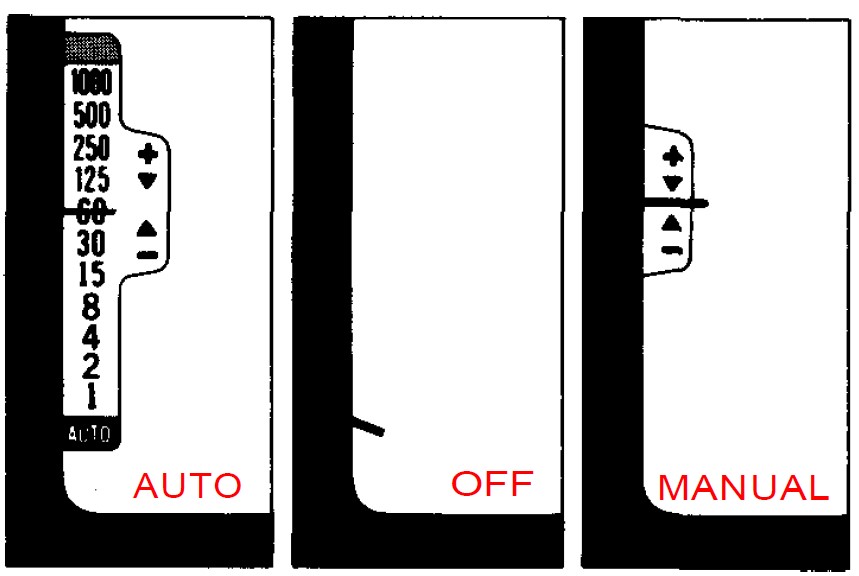

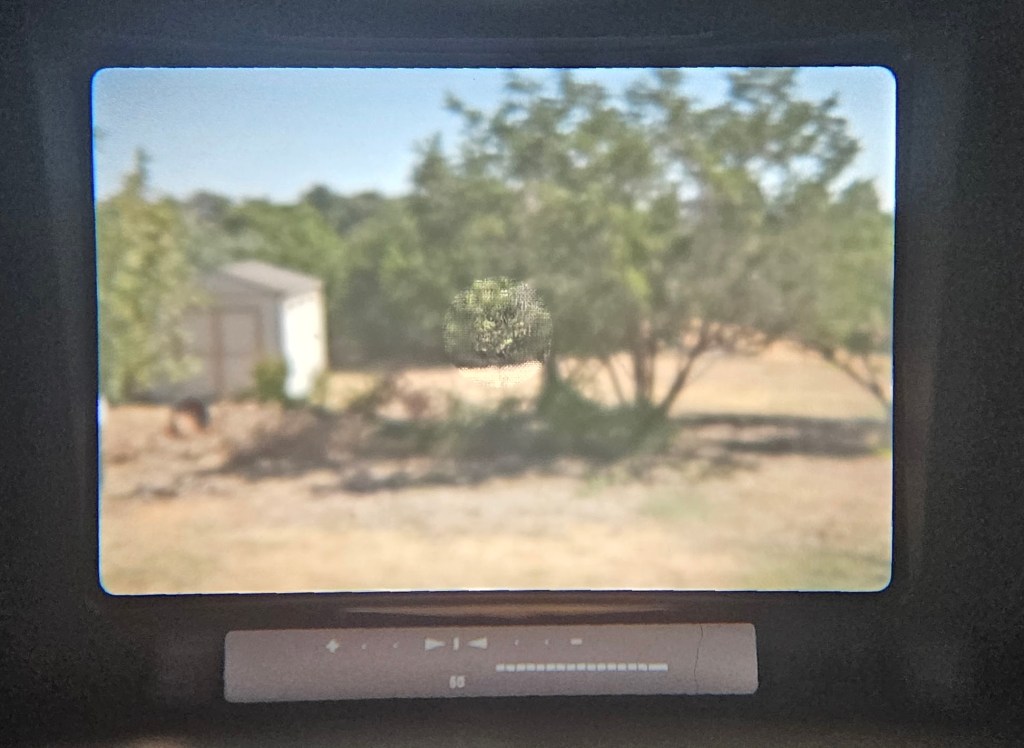
I like the simplicity of the OM System viewfinders. Very clean, bright and clear. I’d like to see my aperture setting – but that’s not a huge deal. If I could have the same meter needle in the OM-4 as in the OM-2, I think I would be happy (but maybe I can never be truly happy).
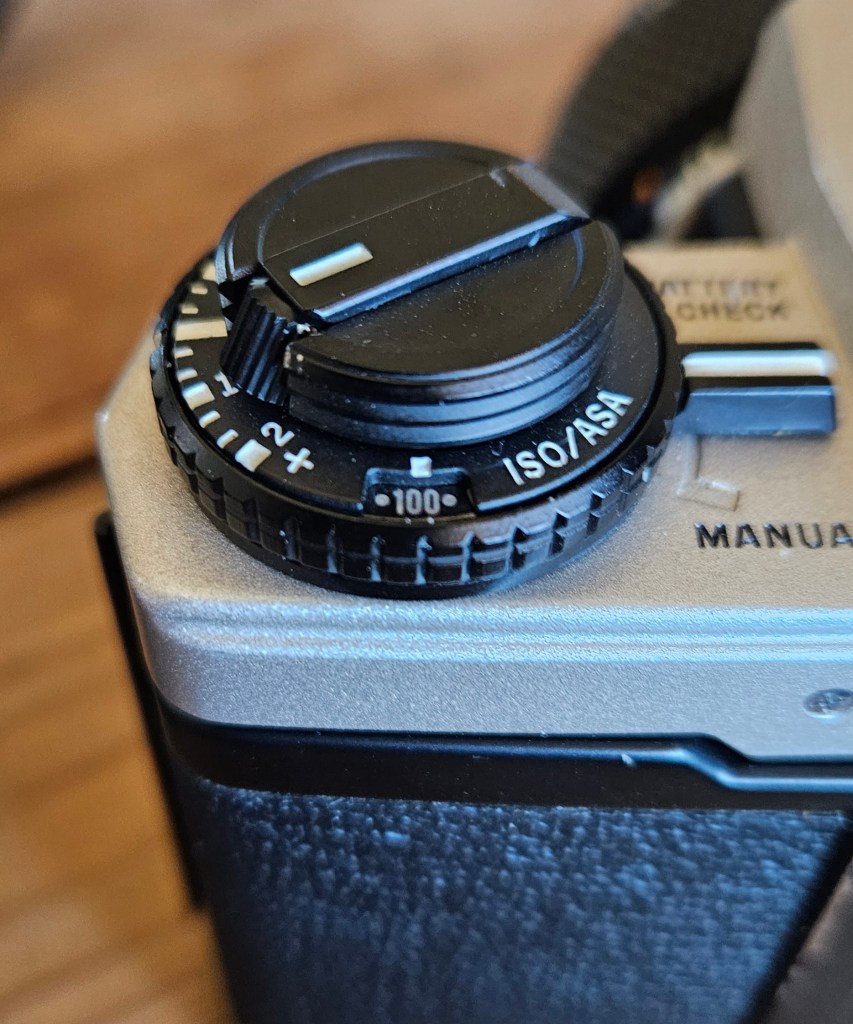
Some other things I like about the OM-4 pertain to build. I love the way the OM-4 (and all the OM cameras) feel in my hands. Solid, but not too heavy. I like the way the shutter sounds – smooth with very little vibration. The film advance on the OM-4, although not as smooth as the Nikon F3, feels very nice. Here’s one little picky thing about the OM cameras – on both the OM-2 and the OM-4, the exposure compensation and ISO are on the same knob. When you set your ISO (ASA on some of these oldies) you have to realign the knob, since it’s all on the same dial, to zero compensate, otherwise changing ISO actually moves the exposure compensation dial plus or minus. On the Canon and Nikon, it’s a bit more sophisticated internally, and the same knob that changes the ISO doesn’t change your exposure compensation. With Olympus, because (presumably to save space) the functions of changing ISO and adjusting the exposure compensation are on the same dial, you have to be sure your compensation is back to zero when you change ISO. A bit of a pain, and one extra step to do – but not terrible. A small +/- is displayed in the viewfinder if your compensation is non-zero – but it can be easy to miss or ignore unless you know what it is.
Below are closeups of the ISO setting dials from my Nikon F3, and Olympus OM-4. On the Nikon (first image) you lift up on the dial where the small viewport shows the selected ISO – and spin the dial to change. This doesn’t impact or effect the exposure comp (on the right side of the dial) which is adjusted by pressing the silver button and turning the knob without lifting it up. In the second image, ISO is adjusted by lifting up the dial and spinning, and compensation is adjusted by turning the knob without lifting. Lifting up the knob/dial to adjust ISO also changes the compensation – so you need to be sure to zero out the compensation after changing ISO.

Canon New F-1
Now, let me talk about my second favorite of these 3 a bit. My second camera of choice would be the Canon New F-1, and one of the main reasons I choose it above the Nikon is that Canon employed a metering needle system – which, as you already know, is something I like. The F-1 (every version) uses a pretty standard match needle system. You actually have 2 needles, one that moves in response to light changes (the actual meter), or shutter speed dial changes, and one that moves when you change apertures. Presumably, you are mostly adjusting apertures in normal practice, and not fiddling with shutter speeds as much. Even though it’s not as simple as the Olympus OM-1/OM-2 needle, it is pretty easy to get used to, and I like it. The viewfinder of the Canon is nice, and the needles are along the right side with shutter speed selection displayed below the needle.
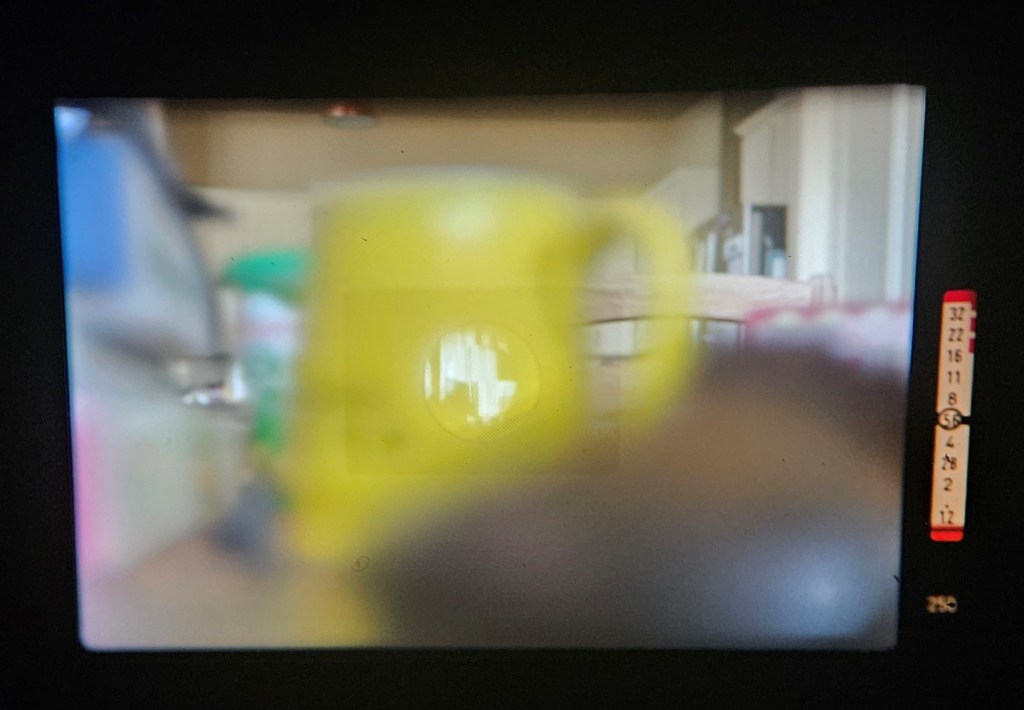
Now, Canon’s viewfinder will change if you’re using an AE finder – so basically a new scale displays along the bottom when you switch to auto mode with an AE finder attached. It simply shows the shutter speed the camera is selecting for you, as you change the aperture. Very nice, and seemless to the photographer – it just shows up when the features are enabled. Here’s a shot of the viewfinder with the AE finder attached and in auto mode.

I’m sorry these images (especially this last one) are a bit fuzzy. You can see the shutter speed scale that appears at the bottom – selected f-stop is to the right of the scale, and the needle shows the automatic shutter speed. This actually works very nicely.
One other thing I should mention about the F-1 that I like. The battery is a 4LR44 (6 volt) that is replaced at the front of the camera. This is an upgrade from previous F-1 models (the original F-1 and the F-1n) which use an older mercury battery that isn’t easily available now. The Olympus and Nikon both take 2 LR44 button style batteries – inserted on the bottom through a screw off cover. Changing the battery in the Canon is slightly easier. However, both types of battery are readily available.
Both the F-1 and the Nikon F3 are built very well – undisputed pro cameras from the early 1980s. I like using both cameras, but they, honestly, are a little overkill for me. I’ve been shooting most recently with my F-1, and it is heavy! I think it’s the heayiest of the 3 – however, my other 2 are titanium versions – so that makes them a bit lighter. All 3 of these cameras have lots of steel parts – not a lot of plastic on them, so that makes them all heavy – like all pro-level cameras of this era.
Nikon F3
Now, concerning the Nikon – it is very well built, and is a great solid camera. The film advance is one of the smoothest ever made, and the shutter and lenses are among the best and toughest. The Nikon, Canon and Olympus all have mechanical shutter modes – so if the battery dies, and you don’t have a spare, you could technically still shoot – however, I think the Canon has the best (most flexible) solution since it has fully mechanical shutter functionality at shutter speeds from 1/90th of a second (I believe) up to 1/2000th of a second. The slower speeds need battery. To engage and use the mechanical shutter, you simply remove the battery (there must be some kind of trigger when the battery is inserted that activates the electronic shutter). The other 2 have one manual shutter speed (1/60th on both, I believe) which is their flash sync speed – so if you’re doing a wedding, and your battery dies, you could keep going in manual mode with your flash… at least that’s the idea. I like that the Canon allows more than 1 speed without a battery. And remember, photographers from this time were used to cameras having no batteries at all. The predecessor of both the Nikon and Canon (the F2 and the F-1) required batteries for the meter only – the shutter was completely mechanical. I think camera companies were aware of hesitancy by photographers to rely too heavily on batteries.
The Nikon F3 was the first version of Nikon’s pro line that incorporated the metering system into the camera body. Both the F and F2 had no metering capability in the bodies – the metering was built into the finder – so changing finders added new/better features, but bodies didn’t change. With the Canon F-1 line, some metering was always built into the camera body. With the New F-1, different metering features could be enabled by switching finders, or by adding a motor drive (you gained shutter priority auto mode only with a motor attached).
So, there you have it. If you don’t own any of these cameras, I hope my brief discussion has helped you to understand the differences, and maybe you’ll want to try one of them. I took my Canon New F-1 on my last trip with me, and I’m actually looking forward to taking the Olympus on my next trip. One other thing I find, when you carry a vintage camera, people are more likely to notice a silver one over a black one. Most new cameras are black – at least that’s my impression. When I see someone with a silver camera, I notice it right away – I can tell it’s different – and I like being different. It’s fun when I see someone else taking film photographs – and I like to see what cameras people choose to use. It’s a great way to strike up conversation with a stranger!
Have fun with film! Enjoy the great outdoors – and hopefully you’re not experiencing the heat we have in Texas this summer – but remember, it will be fall soon!
 Mostly Film Photography (GotFilm.org)
You must be logged in to post a comment.