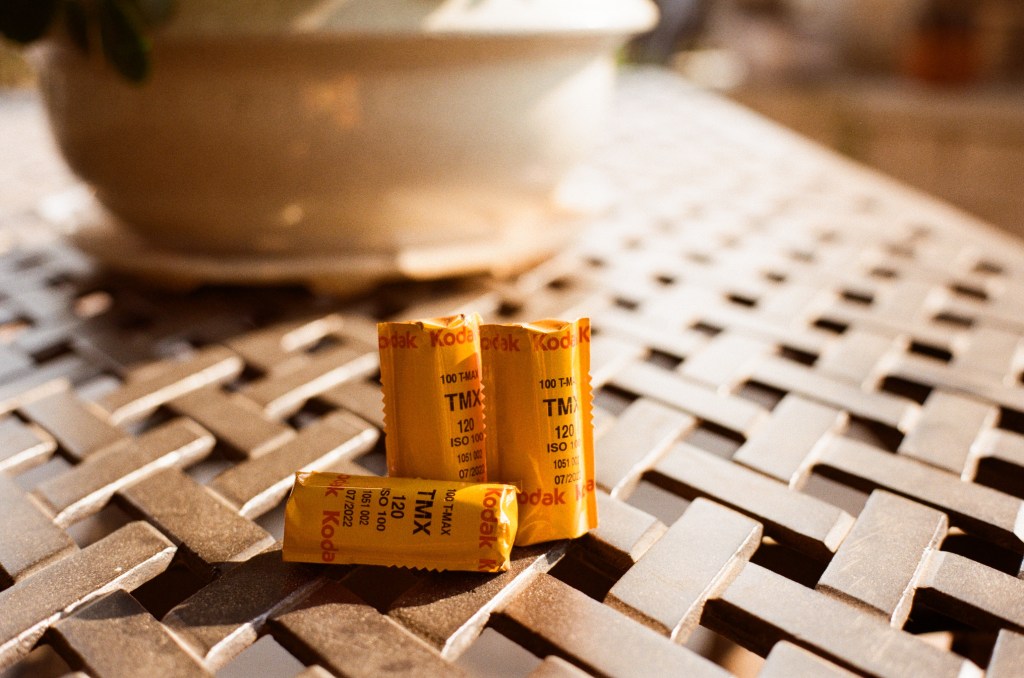
In a digital world, why on earth would I choose to shoot film, or any analog form of photography at all? That’s a very easy question to answer for some (including myself), but it’s also not a trivial one. It’s a valid question though, one that many will ask, and I believe, rightfully so. Let me start by saying that shooting film is not only about results, or quality (with regard to resolution, sharpness, or other technical qualities) of the final image, but also about technique and process. The importance of process is a valid consideration with many art forms, and an argument that many artists make regarding various artistic mediums (like oil painting vs watercolor). Analog photography can include various other photographic mediums – like collodion prints, platinum prints, or Daguerreotypes, among others – that are organic processes as opposed to digital ones. These analog photographic processes involve light sensitive chemicals and a process for exposing, developing and making an image permanent. This process varies, and each process produces images of varying levels of quality and permanence. One of the challenges of early photography was to create a permanent image – one that wouldn’t fade or change with time. I was surprised to find the original plate of one of the first photographs to be made permanent is now on display in the Harry Ransom Center at the University of Texas in Austin. It’s titled, “View from the Window at La Gras“.
My choice to use “traditional” films, the type popularized by Kodak in the early 20th century, is merely due to convenience, and although I may experiment with other forms of analog photography, film photography is what I prefer and have the most experience with, specifically using roll films and sheet films (35mm, 120 and 4×5).
Now that I’ve defined what I’m talking about, let me outline some of the reasons I like to shoot film, and what benefits I think exist with shooting film. Let me also say, I do shoot digital images. I am not saying that I choose film photography exclusively, but that I appreciate, like and actually enjoy the process and results of film photography.
For some, film photography is a novelty. It’s just something they haven’t experienced, and some people just want to try it. For others, it’s what we did for many years, and we already know it. It’s familiar. Some people moved from film to digital and never looked back. Others, like me, stopped shooting film for a time, and then decided to go back and re-experience film.
There are technical qualities of film that I like. I like how every kind of film has its own unique look. I like grain. I like that analog images aren’t always as sharp or smooth as a digital image.
Another thing I like about analog photography is that it’s real. I mean it’s not virtual – living in some digital form that requires electricity to see. An analog image can be seen with nothing more than light – the same way we see everything else. It can be touched and smelled. It’s organic, using chemicals and elements existing in nature. I know this will stir up controversy or disagreement, or maybe healthy discussion, but every digital image you make is, arguably, not real unless you create a physical print. We’re so accustomed to viewing everything on our phones, and a generation, or more, of people only know this way to view photographs – but are digital images real? Can you touch the actual image? What would happen if your phone ran out of power, and you couldn’t charge it, would those images still exist? What if the internet was all of a sudden gone? At the lowest level, those “images” would be merely a series of bits stored on some piece of computer hardware in some data center…
On my desk, I have a box of negatives. They are real. I can touch them; I can see images on them. On the other hand, if I don’t have a phone or a computer or some device with which to view my digital images, I can’t see them.
Maybe I feel more comfortable with something I can not only see, but also touch, or smell. Maybe that’s an older way of thinking.
It seems to me that our digital world is just trying to copy our physical world. I’m a computer programmer at my other job – so I’ve actually been thinking about this for years. I’m not saying I understand it fully – maybe it’s good that I know I don’t understand things fully – but what I do as a programmer, duplicates or copies manual processes. So, I try to automate processes to improve efficiency, speed things up, do more work with less people, and any number of other things. But what I create is virtual. In other words, it doesn’t exist in the “real” world. If we lose power, we have to have generators to keep working. If the internet were gone, we would not be able to use many of the digital tools and applications we’ve created. I fear that we’re so connected to this virtual world that if it didn’t exist, we could not function.
So – is my fear that all the digital content in the world could be gone in the blink of an eye the reason I like film? Or because I don’t consider digital images “Real”? Well, no. I like film for what it is. I like how images render on film. I like grain. I think things that aren’t perfect can still be interesting, artistic, and even beautiful. I like film because I know it. I like film because I feel a little like a mad chemist with my beaker of diluted HC-110 or Rodinal. I like the smell of fixer on my hands. I like the vinegary smell of stop bath. I like film because of the feeling I get when I open my developing tank and unroll a few frames of nicely exposed film – that good feeling never goes away! Most of all, I like film photography because it’s fun!
And, to all you film photographers out there, when we wake up one day and none of our devices turn on, we’ll be just fine because our film cameras will still work. In the back of my mind, I know if this does happen, none of us will be thinking of taking photos – at least for the first few days…
Happy World Photography Day – a few days late!
 Mostly Film Photography (GotFilm.org)