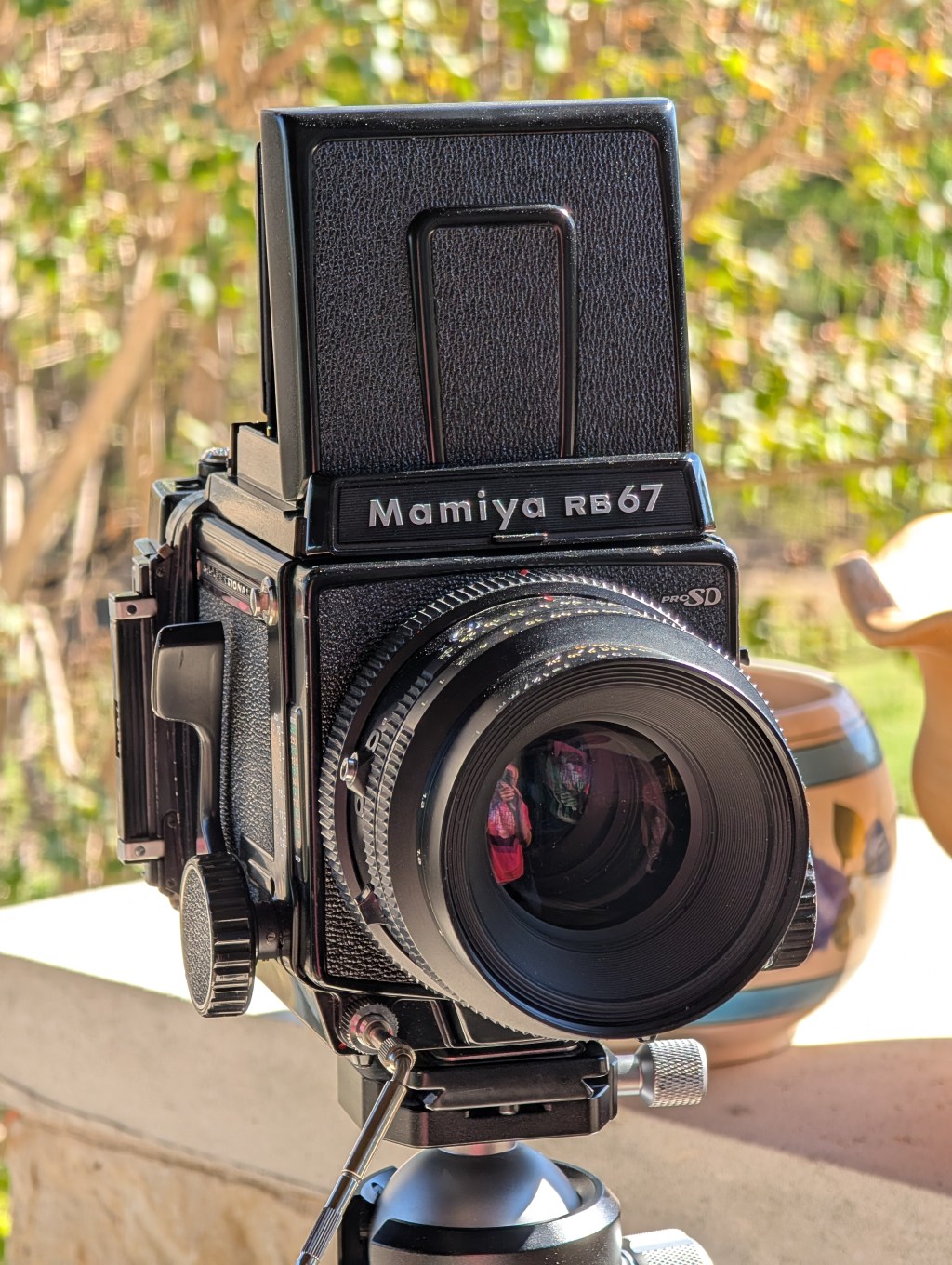
The Mamiya RB67 was first released in 1970, then the Pro-S in 1974 and the Pro-SD in 1990 – so it had a long life through a couple revisions before the RZ electronic bodies eventually replaced them. It is interesting though that the last RB (RB67 Pro-SD) sold new for quite a long time, at the same time the RZ bodies were being sold, because it was so popular.
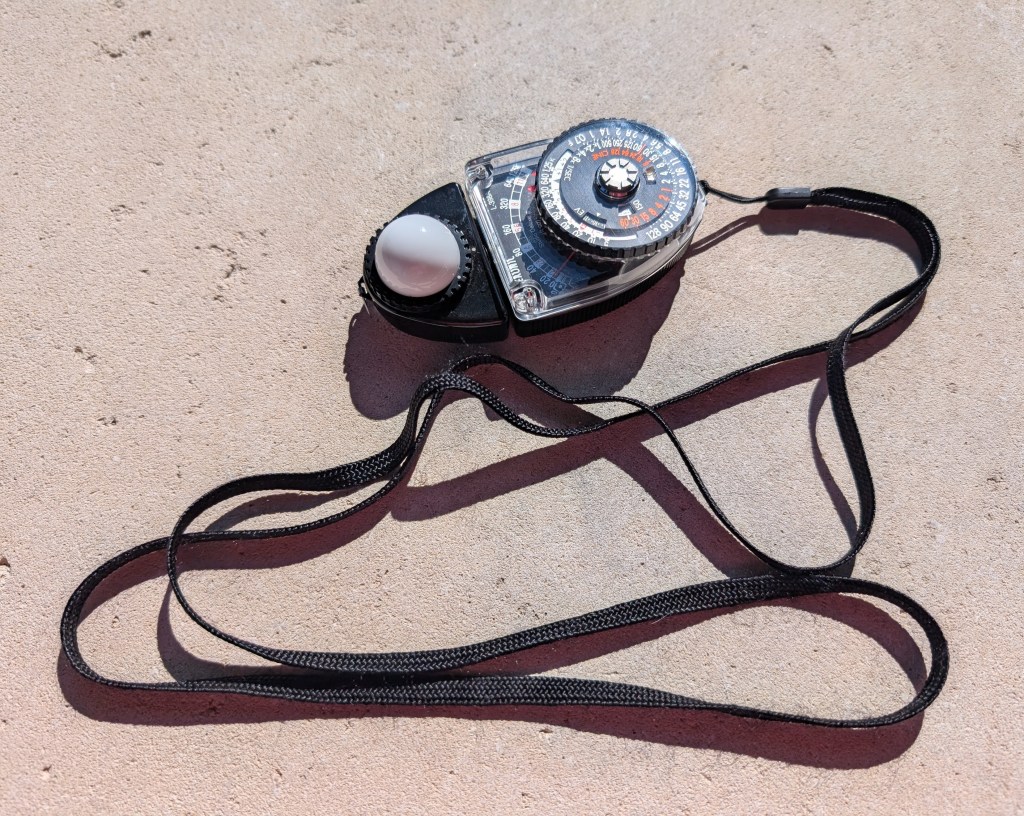
The RB67 is completely mechanical, with no batteries – so you necessarily had to use an external light meter since none was built into the camera body. I love my Sekonic Studio Deluxe meter, and it works great alongside the RB67.
I’ve had people comment to me that the RB67 is a studio camera and I shouldn’t be using it in the field, while I was carrying it around on a tripod. I, however, don’t think it should be considered “only” a studio camera. I love the 6×7 format, and it is a large, heavy camera to carry around, but I consider that a small price to pay for the beautiful negatives it produces, not to mention the big, beautiful waist level viewfinder. But maybe that’s just me – you might agree that it’s too heavy to carry around in the outdoors. That’s one of those things that I can’t decide for you. You have to try it and decide for yourself.
I should explain some of the unique features of the RB. First, it employs a leaf shutter built into the lenses – so each lens has its own shutter. This works well, and the leaf shutter is quiet, and reliable. But I can’t help thinking that having a shutter in each lens could mean that the shutter speeds are slightly (at least) different on each lens. I haven’t noticed any differences in my lenses (I only have a couple) so maybe it won’t ever be an issue for me. Having a shutter in each lens could make the lenses more expensive, and more complicated to repair, I suppose. Again, that hasn’t been an issue for me. I do like using a camera with a leaf shutter though. It’s very smooth working and very quiet. Compared to medium format with a focal plane shutter, this camera sounds much better. Now, remember, the leaf shutter maxes out at around 1/400 to 1/500 of a second speed (physical limitations) – while focal plane shutters can achieve faster shutter speeds. So, there are pros and cons both ways.
Since a 6×7 (or 6×8 even) capable camera body must be a bit larger than a 6×6 or a 6×4.5, it also can have a larger viewfinder. I love the viewfinder on the RB67! It’s bright and easy to visualize a subject through. I recently purchased a split image focusing screen since my eyes are bad, and using the plain ground glass with a center microprism spot was getting a bit hard for me. I like the split image screen – but honestly, if my vision were better, I’d love just focusing on a plain screen with the center spot. It’s very beautiful – almost as nice a viewing through ground glass on a 4×5 view camera. I love seeing my subject with both eyes on the ground glass. I prefer using the waist level finder and just looking down into the viewfinder. It’s so different than looking with one eye through an eye level viewfinder, for example. It helps me see the image just as if I were looking at a final version in a frame or on a computer screen. It’s very natural. This is the same for all medium format cameras with a waist level finder, but because of the RB’s size, I love looking through its viewfinder. Maybe that’s another reason I’m willing to carry around a larger camera. Maybe the beautiful viewfinder helps make it worth the extra weight.
The RB67 has a couple other features I should mention. First, let me point out the rather unique way it operates mechanically. The shutter cocking mechanism is separate from the film advance. So, you have 2 operations to perform before making an exposure, whereas most other medium format cameras, as far as I know, have tried to accomplish this with one step. The Bronicas and the Hasselblads do it with just one step. Others I believe also do, but I can’t say for sure how all work, I just know what I’ve used. The RB67 is the only camera I know of that requires 2 steps – film advance and shutter cocking – separately. I don’t mind this. That being said, I’ve seen motorized film backs for sale – so presumably, with one of these backs, as you shoot, the film advance is automatic, and all you have to do it cock the shutter. I’ve noticed this with 6×8 film backs. I’m not sure if a motorized back is available in 6×7. However, a photographer gets used to whatever their process needs to be in order to use their camera. After a day or so, you start to not even think about it, it’s just the way it works. And slowing things down a bit isn’t really a negative for me – I actually like taking my time and focusing on my subject and how I’m going to capture the image. So I don’t mind this, but it is a little different. Next, the RB (and the RZ as far as I know) allow the film back to be rotated (RB=Rotating Back) so you can shoot in either portrait or landscape format without rotating the entire camera. I think this is a great feature since it allows flexibility while shooting – and if the camera is on a tripod (which it usually is for me) this is way easier than somehow rotating the whole camera. This isn’t an issue with Hasselblads or other 6×6 cameras – and that’s actually why some like them (I’ve heard that was a big reason Ansel Adams preferred 6×6). I like the 6×7 format – it’s large and is slightly rectangular, much like 4×5 – so you can shoot portrait or landscape and compose full frame in camera reducing the need to crop your image (which I’m trying not to do).
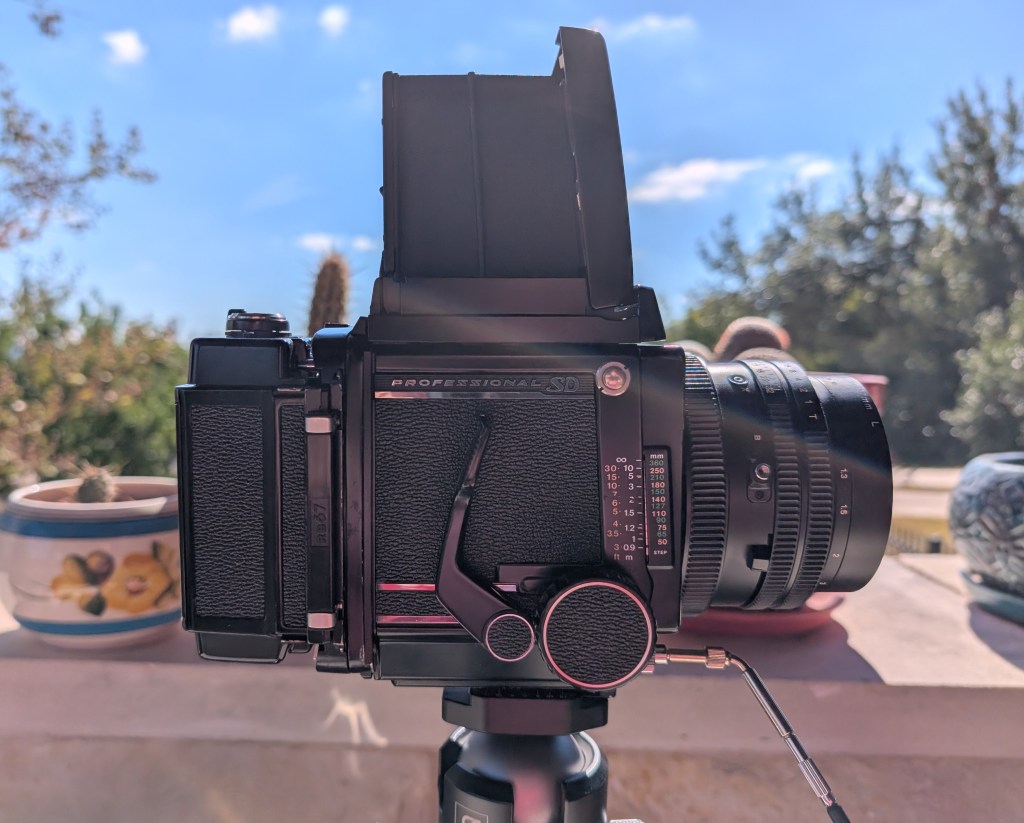
Here’s another unique feature of the RB67. Since it’s a bellows focusing camera (the focusing mechanism isn’t built into the lens itself but is part of the camera) the lens elements are fixed in the lens. Most modern lenses have a “floating” element(s) feature built into their focusing mechanism. When you focus the lens, the various lens elements don’t necessarily all move the same amount, depending upon the lens. This doesn’t happen with the RB67 lenses. To accommodate this, some lenses have a special dial to adjust the focus just slightly by moving these “floating” elements – not to really focus, but to fine tune the elements for the best possible image and sharpness. You can just leave it on infinity, and it will work reasonably well at all distances, but for the best possible image you should set this to the current distance from your subject when the feature is available. This is an extra step to remember with some lenses. Also, since focusing and distance is not displayed on the lens itself, there is a metal plate on the side of the bellows – a legend/chart to assist with determining the current distance to your subject – which includes all (most) lenses (see the image below). To use it, you find your lens’ focal length, and the corresponding white dot. That will identify the line that ultimately shows your distance in feet and meters. If you don’t use this camera ever day (like me) this takes a little time to get used to when you use it. Fortunately, unless you’re using flash, or there’s some other reason you need to know the distance to your subject, you don’t need to pay much attention to it. I like to understand how things work though – so I try to understand it even if I don’t need to.

So these are some of the particular (maybe unique) features of the RB67. Now that I’m writing this all down I’m thinking, “This camera is a lot of work” if you want to understand all these features. Well, it’s not that bad – and like I said before, once you shoot with it for a day or so you just get used to the way it works. Thinking back to my previous post about the Zenza Bronica EC-TL II, that camera seems pretty simple compared to this. I guess I want you to know what you’re getting yourself into if you want to try shooting with the RB67… I’m not trying to scare anyone away!
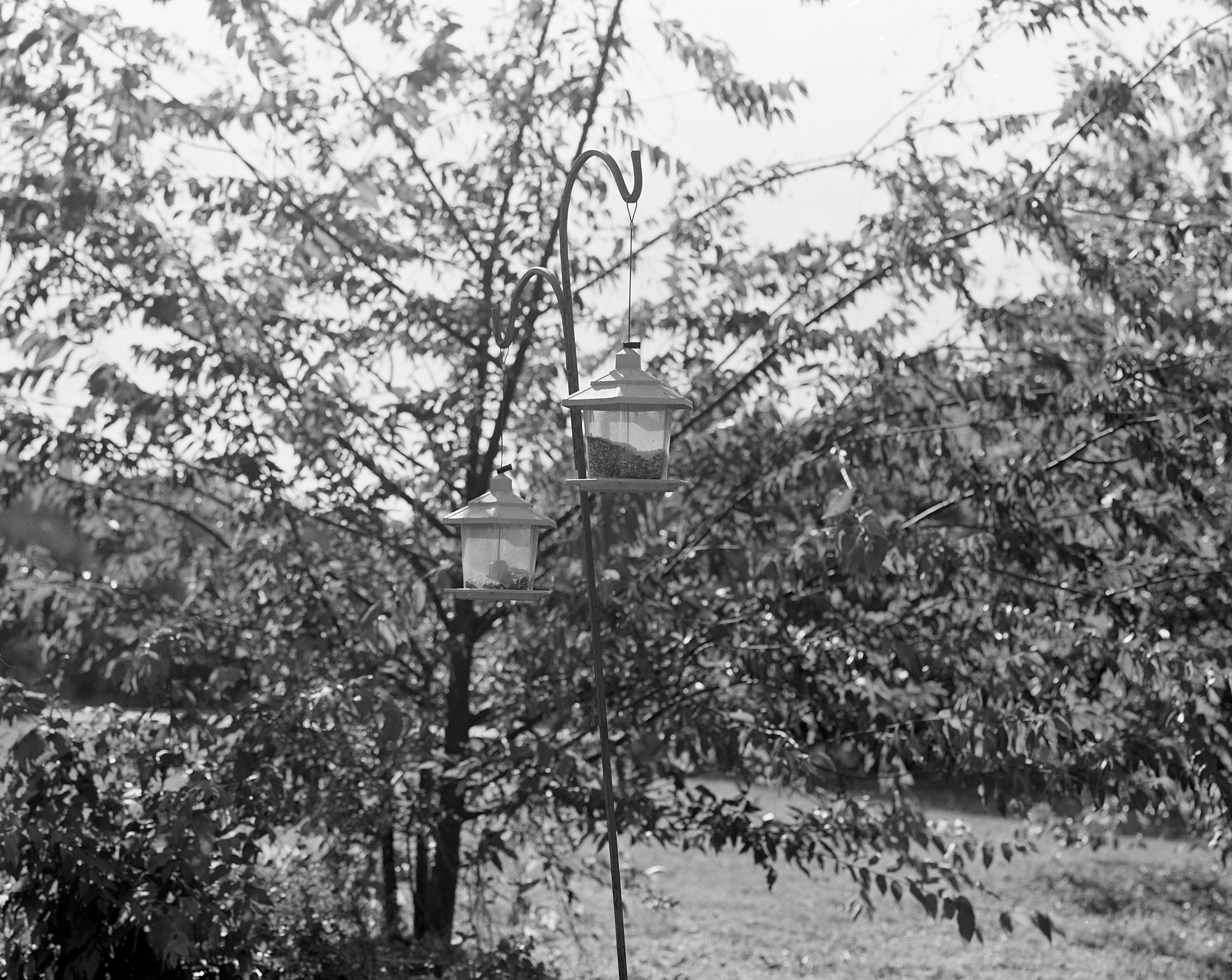
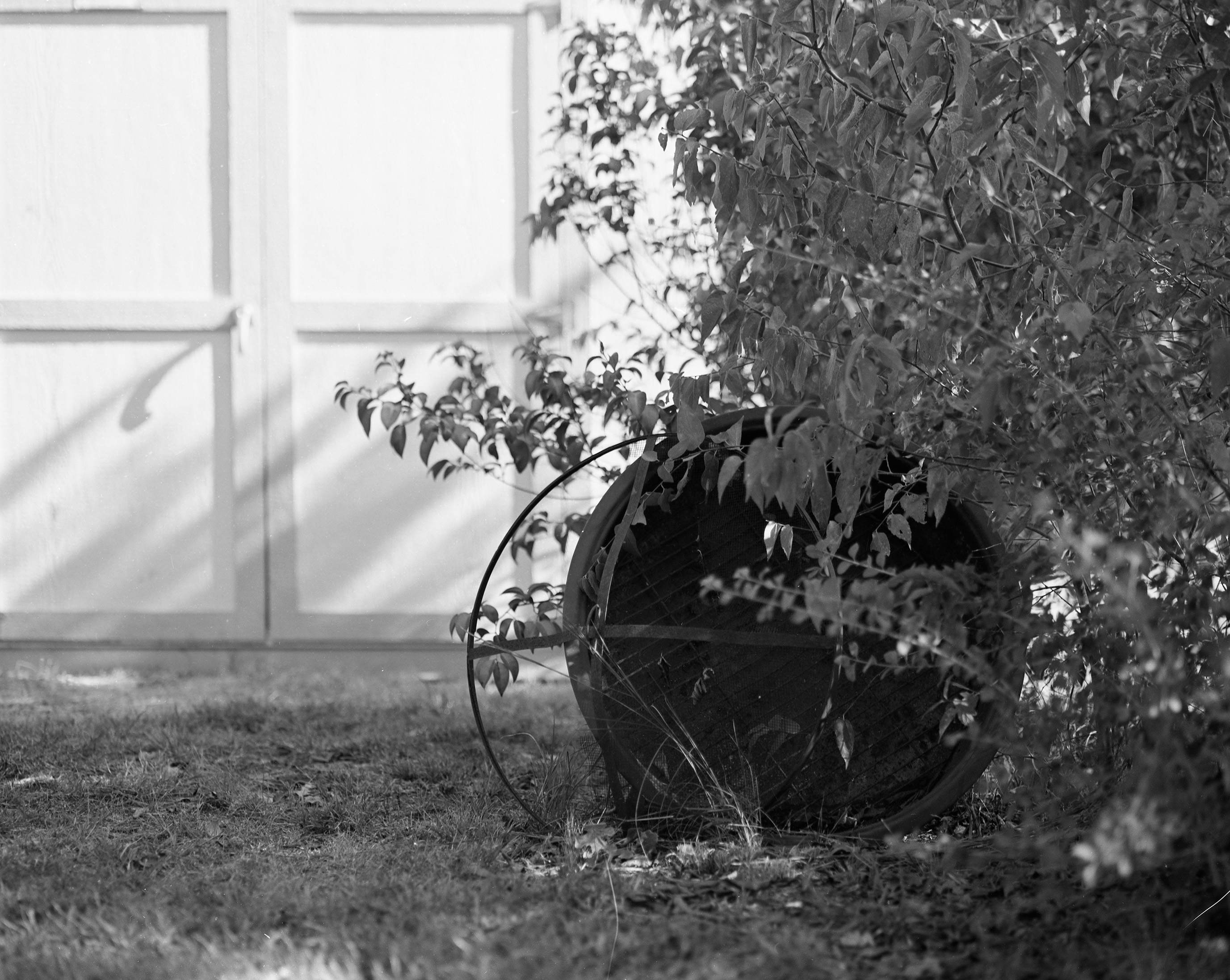
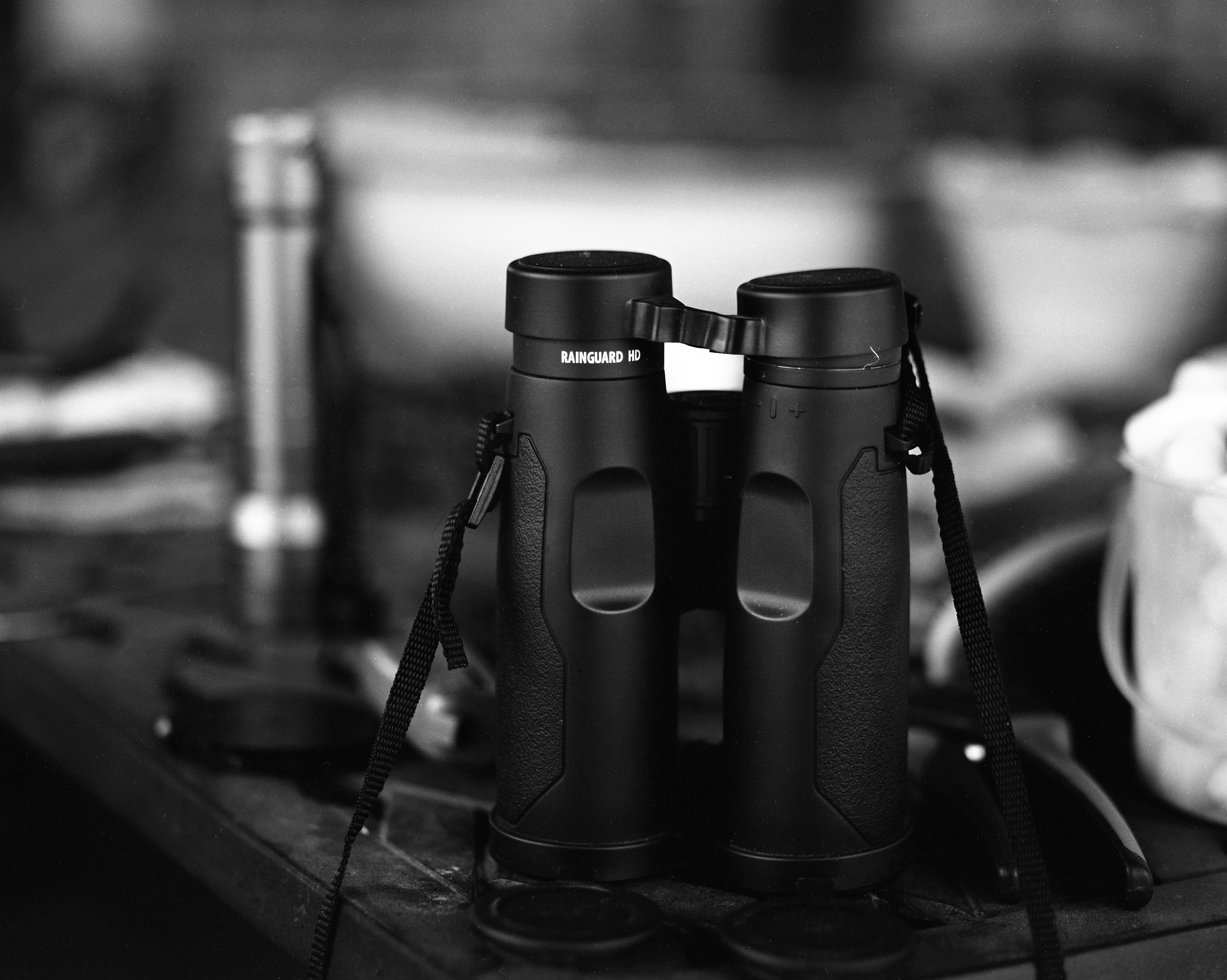
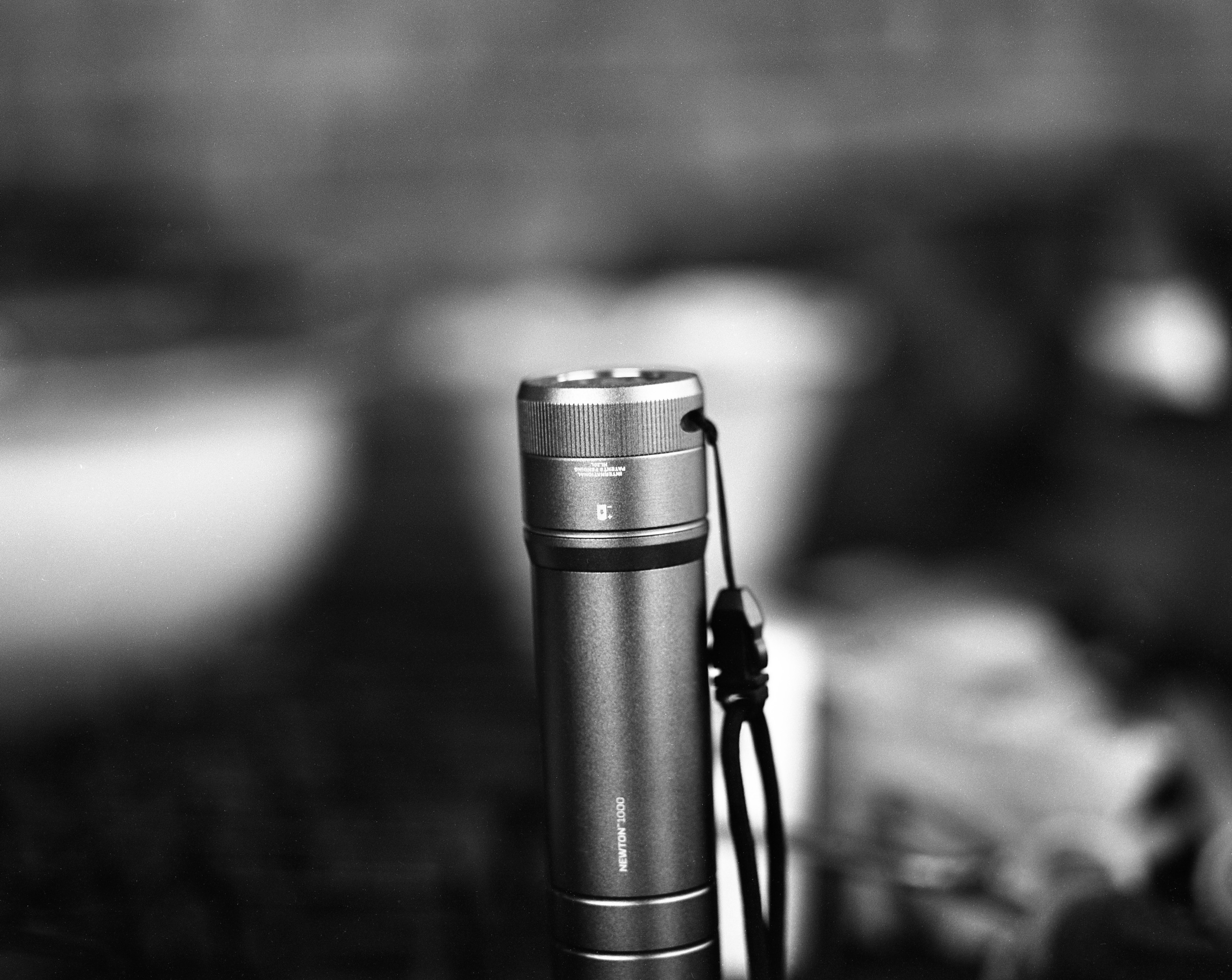
That all said, here’s a few shots I took around my yard. The last couple were taken to show the sharpness (trying to focus on the words on the binoculars and flashlight) of the lens I used (127mm f/3.5 K/L) and I also like the background in some of the photos.

All-in-all, this is a very nice camera – I love the 6×7 format, and the viewfinder. I don’t like that it’s big and heavy – and it is a bit complex to use. Even though its big and heavy, I still don’t mind carrying it outside – and I don’t think it should be relegated to the studio only.
 Mostly Film Photography (GotFilm.org)
You must be logged in to post a comment.